
Designing Admixtures: Effects of PCE on blending with older generations of superplasticizers
Mechanism and Impact of Lignosulphonates and SNF/SMF Blends with Polycarboxylate Ether
RAYYANAH ALMUTAIRI, M.S .
Abstract
As the construction industry demands concrete with higher workability and lower water-cement ratios, superplasticizers have evolved from simple bio-based polymers to sophisticated synthetic graft copolymers. This article explores the progression of technology through three generations lignosulfonates (LS), sulfonated naphthalene/melamine condensates (PNS/SMF), and polycarboxylate ethers (PCE) and evaluates the chemical interactions that occur when blending PCE with these earlier generations. Ultimately, this work provides a framework for understanding rheological performance and cost-effectiveness in modern concrete design.
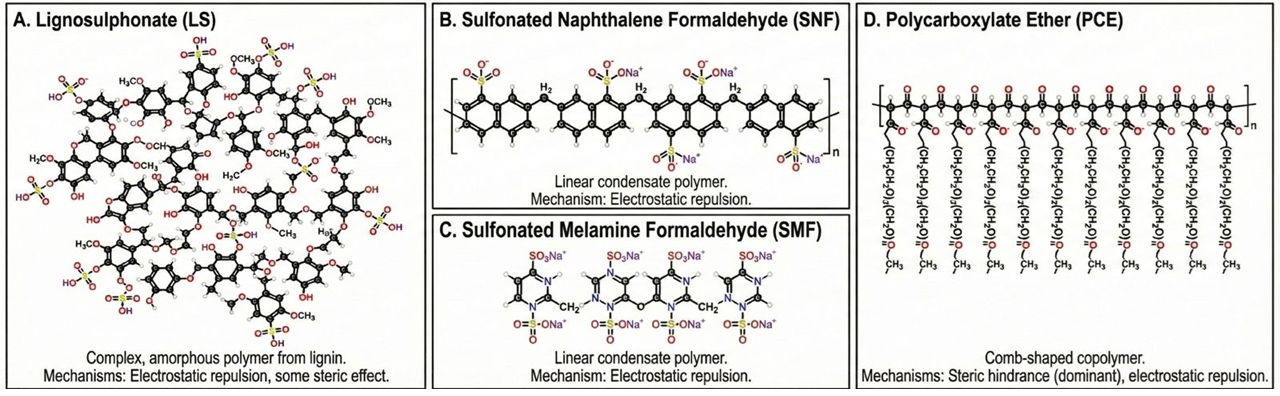
A. Lignosulphonates, B. Sulphonated Naphthalene Formaldehyde,
C. Sulphonated Melamine Formaldehyde and D. Polycarboxylate Ether
Introduction: The Evolution of Superplasticizer Admixtures
Superplasticizers, which are potent water reducers, have revolutionized concrete mix design due to their ability to allow low water‐cement ratios while maintaining the workability of concrete. Superplasticizers, characterized by high-molecular weight polymers, are soluble in water [1]. These admixtures have evolved through three generations.
In the 1930s, lignosulfonates were introduced as concrete plasticizers, enabling water reduction while maintaining concrete workability. They are now recognized as the first generation of superplasticizers [3]. Lignosulfonates are bio-based polymers produced as byproducts of sulfite pulping in the paper industry [3]. Structurally, they retain an aromatic lignin framework arranged in a random, poly-branched network, giving them an anionic, and water-soluble character [3] [4]. In concrete, lignosulfonates typically deliver about 5–15% water reduction at standard dosages and may cause moderate set retardation [4].
Polynaphthalene sulfonates (PNS) were introduced to the admixture market in 1960 and are widely used today as high-range water reducers (second-generation superplasticizers). Structurally, PNS are naphthalene sulfonic acid–formaldehyde condensates. Naphthalene (C10 H8) is first sulfonated with sulfuric acid (H2SO4) to form β-naphthalene sulfonic acid, then condensed with formaldehyde (CH2O) in an aqueous medium to yield a mostly linear, anionic polymer bearing sulfonic acid/sulfonate groups (SO3H/SO3–) [4]. In concrete, PNS generally provide stronger dispersion than lignosulfonates and enable high-range water reduction; however, performance can be time-dependent and sensitive to cement–admixture compatibility [4]. In addition to PNS, second-generation superplasticizers include melamine sulfonate–formaldehyde condensates (often referred to as SMF), which have been used since the mid-1970s. These materials are produced via condensation of melamine (2,4,6-triamino-s-triazine; C3N6H6) with sulfite (SO3-2)) and formaldehyde (CH2O). In concrete, SMF offers water reduction and plasticizing performance comparable to PNS, with typically lower retardation, while PNS may provide marginally better slump life [4].
The third generation of superplasticizers, introduced in the late 1980s, marked a major shift in dispersion technology with the emergence of polycarboxylate ethers (PCEs). Unlike earlier lignosulfonate- and naphthalene/melamine-based superplasticizers that rely mainly only on electrostatic repulsion, PCEs are specially made dispersants whose performance can be tuned through polymer architecture. PCEs are commonly described as comb-shaped graft copolymers [4], consisting of an anionic polycarboxylate backbone (often derived from acrylic/methacrylic units) grafted with long polyether side chains (PEG/PEO), typically introduced via macromonomers such as HPEG, TPEG, and EPEG types. In concrete, PCEs commonly enable up to 40% water reduction and depending on design, can provide improved slump retention and strength development [5]. However, their efficiency is highly dependent on cement, supplementary cementitious materials (SCM) chemistry, and the ionic environment of the pore solution.
Dispersion Mechanisms: How the three generations of superplasticizers work?
The dispersion mechanism of LS (first-generation superplasticizers) is mainly driven by electrostatic repulsion. As natural, polymers containing sulfonate, carboxylate, and phenolic groups, LS molecules adsorb onto cement particles through ionic interactions and hydrogen bonding. This adsorption increases the negative surface charge of cement grains and promotes formation of an electrical double layer [6] [7]. The resulting repulsive forces reduce interparticle attraction and lower the paste yield stress. However, this mechanism is inherently limited by the adsorbed layer is relatively thin, and at higher surface coverage LS can promote bridging flocculation, where polymer chains connect multiple particles, reducing dispersion efficiency and limiting further water reduction [6].
Second-generation superplasticizers (PNS or SMF) primarily act through a strong electrostatic repulsion mechanism. These synthetic, largely linear aromatic polymers contain pendant sulfonate groups that promote adsorption on cement surfaces, commonly via interactions mediated by Ca2+ in the pore solution. The resulting high surface coverage increases the negative zeta potential and strengthens the electrical double layer, producing powerful repulsion between particles and high initial flowability [8]. However, slump retention may be limited because adsorption can be rapid and extensive, and the rising ionic strength of the pore solution can progressively screen electrostatic charges over time [8] [4].
Third-generation PCE superplasticizers achieve dispersion by combining electrostatic and steric mechanisms, with steric effects usually dominating. The anionic backbone adsorbs onto cement surfaces primarily through carboxylate groups, which can contribute to initial charge-based repulsion. At the same time, the grafted PEG (PEO) side chains extend into the pore solution and create a thick, hydrated layer that acts as a physical barrier, preventing close particle approach even at relatively low adsorption densities [8]. This polymer brush/cloud layer maintains particle separation and viscosity control even when electrostatic interactions are partially screened by the high ionic strength of the pore solution, enabling high-range water reduction and improved slump retention [9] [8].
Blending PCE with Different Generations of Superplasticizers
Hybridizing polycarboxylate ethers with oldest generation of superplasticizer such as LS, SNF, or SMF optimizes rheological performance through modulated adsorption kinetics. The following analysis examines how these interfacial interactions dictate workability retention and hydration evolution in practical concrete applications.
1. Blending Polycarboxylate Ethers (PCE) with First Generation
Blending polycarboxylate ethers (PCEs) with LS is one of the most common hybrid strategies because it combines PCE-driven steric dispersion with LS-driven electrostatic plasticizing and hydration control, enabling more cost-effective and robust workability management in practical concrete production. The interaction between PCE and LS is largely governed by competitive adsorption on hydrating cement phases, particularly tricalcium aluminate (C3A) and tricalcium silicate (C3S). In a simultaneous addition scenario, LS molecules often smaller and more mobile than the large comb-shaped PCE can diffuse rapidly toward the highly reactive aluminate-rich surfaces. Upon contact with water, C3A hydrates quickly and forms early aluminate hydrates such as ettringite (AFt), creating adsorption-active surfaces that strongly attract anionic admixtures.
LS therefore tends to preferentially occupy a significant fraction of these early C3A-related adsorption sites and acts as a “sacrificial” agent. By satisfying much of the aluminate adsorption demand, LS can reduce unproductive PCE consumption on aluminate phases and keep a higher fraction of PCE available in the pore solution. As hydration progresses, the preserved PCE can adsorb more effectively on C3S-dominated surfaces, maintaining dispersion over time and improving workability retention (i.e., reduced rapid slump loss), especially under variable cement chemistry and site conditions [10] [11].
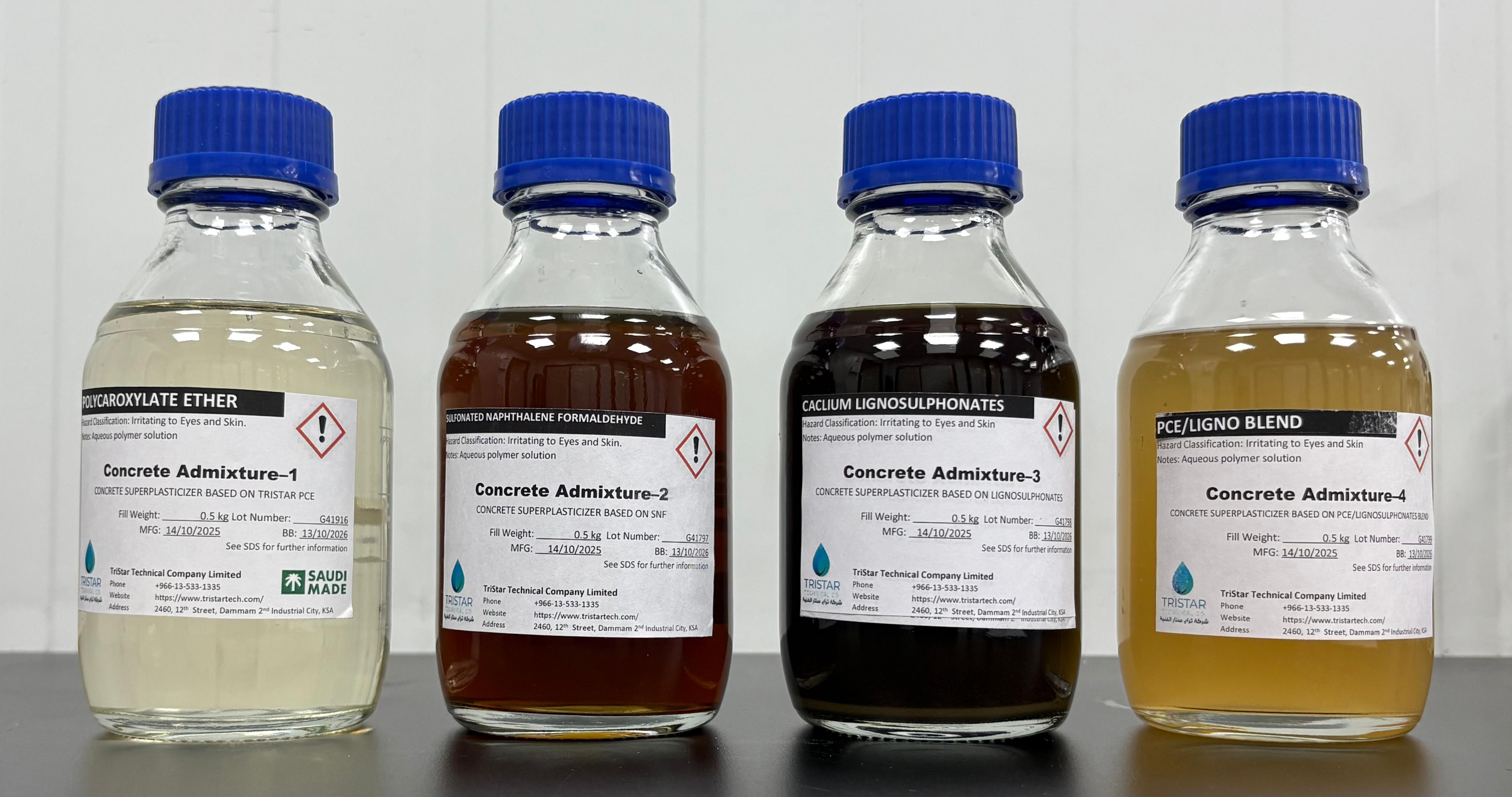
2. Blending Polycarboxylate Ethers (PCE) with Second Generation
Blending PCE with sulfonated naphthalene (SNF) or sulfonated melamine formaldehyde (SMF) presents a different set of challenges than LS blends, and is often explored for robustness under variable raw materials (e.g., clay contamination) despite higher compatibility sensitivity to the ionic environment. Historically, PCE/SNF (and sometimes PCE/SMF) mixing was associated with rapid fluidity loss. Mechanistic interpretations point to elevated sulfate/salt levels in some commercial SNF and SMF products (often residual Na2SO4 from synthesis/neutralization), which can interfere with PCE performance through two coupled effects:
- sulfate competition for adsorption-active sites that weakens PCE anchoring and may promote partial desorption, and
- ionic-strength screening that contracts the PCE coil, reducing effective surface coverage and steric efficiency [12] [13].
Sulfonated melamine formaldehyde (SMF) can behave differently from SNF in terms of setting and early hydration response. In practice, SMF is often selected in precast applications because it typically shows less setting retardation than SNF and many lignosulfonate-based systems, supporting faster turnaround cycles. In precast production, blending PCE with SMF can create a practical performance balance: the PCE component provides high initial flow and strong dispersion (useful for filling dense reinforcement and complex molds), while the SMF component supports earlier stiffening and faster strength gain that can facilitate early demolding. Mechanistically, this synergy is commonly attributed to SMF delivering effective electrostatic dispersion without excessively delaying early hydration kinetics in many binder systems. When combined with a suitably designed PCE (and appropriate sulfate balance), the blend can maintain high workability while improving early-age reactivity compared with a PCE-only approach although the magnitude of the benefit remains cement- and dosage-dependent [14].
Conclusion
Blending different generations of admixtures offers a strategic path toward more robust and cost-effective concrete. The synergy between PCE and first-generation lignosulfonates (LS) proves particularly effective, as the LS acts as a sacrificial agent that satisfies the high adsorption demand of early aluminate hydrates, thereby “sparing” the high-performance PCE for long-term workability. However, the transition to blending with second-generation sulfonated condensates (SNF/SMF) requires more careful management of sulfate levels and ionic strength to prevent rapid fluidity loss. Ultimately, the successful hybridization of these chemistries allows for specially made concrete that balances initial flow, slump retention, and early strength gain, meeting the rigorous demands of modern infrastructure.
About TriStar Technical Co.:
TriStar Technical Co. is a Saudi Arabian company and the leading provider of Polycarboxylate Ethers (PCE) in the region. With our state-of-the-art manufacturing facility in Dammam, we offer a diverse range of PCE grades, including high-range water reducers, slump retainers, hybrids, early strength agents, viscosity-reducing and clay-tolerant solutions. Our commitment to quality and customer satisfaction enables us to meet the specific needs of the construction industry.
References:
- M. Bediako, “Superplasticized vs. Conventional Concrete: A Comparative Review,” Materials Sciences and Applications, pp. 271-284 , 2024.
- M. R. D. P. M. C. G. Noel P. Mailvaganam, Chemical Admixtures for Concrete, London: CRC Press, 1999.
- J. Ruwoldt, “A Critical Review of the Physicochemical Properties of Lignosulfonates: Chemical Structure and Behavior in Aqueous Solution, at Surfaces and Interfaces,” Surfaces, pp. 622-648, 2020.
- I. S. R . FLATT, “Superplasticizers and the rheology of concrete,” in Understanding the rheology of concrete, Woodhead Publishing Limited, 2012, pp. 144-208.
- E. M. A. Ejaz, “PCE: Promoting Construction Sustainability,” 05 06 2023. [Online]. Available: https://tristartech.com/en/pce-promoting-construction-sustainability/.
- B. Damien, F. Sami, F. Vincent, C. Antoine and A. Florent, “Origin and industrial applications of lignosulfonates with a focus on their use as superplasticizers in concrete,” Construction and Building Materials, p. 124065, 2021.
- C. Samyukta, J. Trilochan, D. Saswati, P. Vighnesh and D. Debadutta, “Rheological influence of sodium lignosulfonate (NaLS) on cement-fly ash slurries,” Journal of Molecular Liquids, p. 129167, 2025.
- R. X. L. X. Z. Z. Q. &. W. J. Huang, “A Review on Concrete Superplasticizers and Their Potential Applications for Enhancing the Performance of Thermally Activated Recycled Cement.,” Materials (Basel, Switzerland), 2024.
- Z. H. K. C. M. C. H. Z. L. &. Y. T. Kou, “Synthesis of Biomass Polycarboxylate Superplasticizer and Its Performance on Cement-Based Materials.,” Materials (Basel, Switzerland), p. 3416, 2025.
- T. J. V. a. C. M. Suthan Kumar N, “Effect of cement kiln dust and lignosulfonate on cement paste: a rheology and hydration kinetics study,” Materials Research Express, 2023.
- Y. A. N. L. S. G. L. R. A. &. D. W. K. El Bitouri, “Effect of Plasticizer on Hydration and Rheological Behavior of Cement Pastes.,” CivilEng, pp. 748-759, 2022.
- Y. &. D. S. G. Qian, “Different Effects of NSF and PCE Superplasticizer on Adsorption, Dynamic Yield Stress and Thixotropy of Cement Pastes.,” Materials, p. 695, 2018.
- P. Yan He, P. Shuhua Liu, P. Qi Luo, P. Yang Zhang, P. Xiucai Wang and P. Gaoyu Liao, “Effects of sulfates on adsorption-dispersing behavior of PCEs with different carboxylic densities,” Advances in Cement Research, p. 496–505, 2021.
- M. G. R. S. Aakanksha Pundir, “Evaluation of properties of gypsum plaster-superplasticizer blends of improved performance,” Journal of Building Engineering, 2015.