Clay-Tolerant PCE Polymers
TriStar’s Advanced Superplasticizers for Clay-Bearing Concrete
Engr. Muhammad Ali Ejaz
Introduction:
Concrete mixes containing clay-bearing aggregates present unique challenges. Clay fines on sand or gravel can adsorb conventional admixtures, causing sudden slump loss and higher water demand[1][2].
TriStar Technical Co. has addressed this problem with a family of clay-tolerant polycarboxylate ether (PCE) polymers specially developed for use in such conditions. These proprietary PCE superplasticizers offer exceptional water reduction, superior slump retention, and outstanding clay tolerance, even when working with “dirtier” aggregates or diverse cement blends. Recent patent literature highlights the value of this approach: a “mud-resistant, slow-release and slump-preserving” PCE admixture can solve issues of high clay content, poor conventional PCE compatibility, and large slump loss while maintaining low cost and simplicity[3].
TriStar’s innovative clay-tolerant PCE line brings these benefits to concrete producers in a single, easy-to-use solution.
Tackling Clay Impurities in Concrete Aggregates
Clay contamination in aggregates is notorious for destabilizing concrete workability. Fine clay particles have enormous surface area and often carry negative charges, so they attract water and admixtures, robbing the cement of needed plasticizer[2][4]. As a result, fresh concrete made with unwashed sand or gravel can stiffen quickly, with a dramatic loss of slump and workability[5][1]. In conventional practice, the options to mitigate this include washing aggregates (which is labor- and water-intensive), or using additional chemical aids like clay binders or extra doses of admixture – all adding cost and complexity. Studies show that a normal PCE superplasticizer’s performance is “negatively affected by all types of clay”, especially swelling clays like montmorillonite, often causing great workability loss[1][5]. In contrast, modified polymers can be far more robust: for example, an amide-modified PCE was much less affected by clay, maintaining fluidity where a conventional PCE failed[1]. This validates TriStar’s strategy – the need for a polymer that can withstand clay interference and keep the concrete workable.
Notably, clay-tolerant superplasticizers allow ready use of lower-quality or clay-rich aggregates without washing, which “alleviates the need for washing clay-containing sand” and thus promotes more sustainable (and cost-saving) concrete production[6]. TriStar’s clay-tolerant PCEs make it feasible to use local aggregates “as is,” reducing material preparation costs and conserving water. Moreover, by preventing clay from deactivating the admixture, these polymers ensure the intended water reduction and slump flow are achieved in practice.
TriStar’s Clay-Tolerant PCE Polymer Line
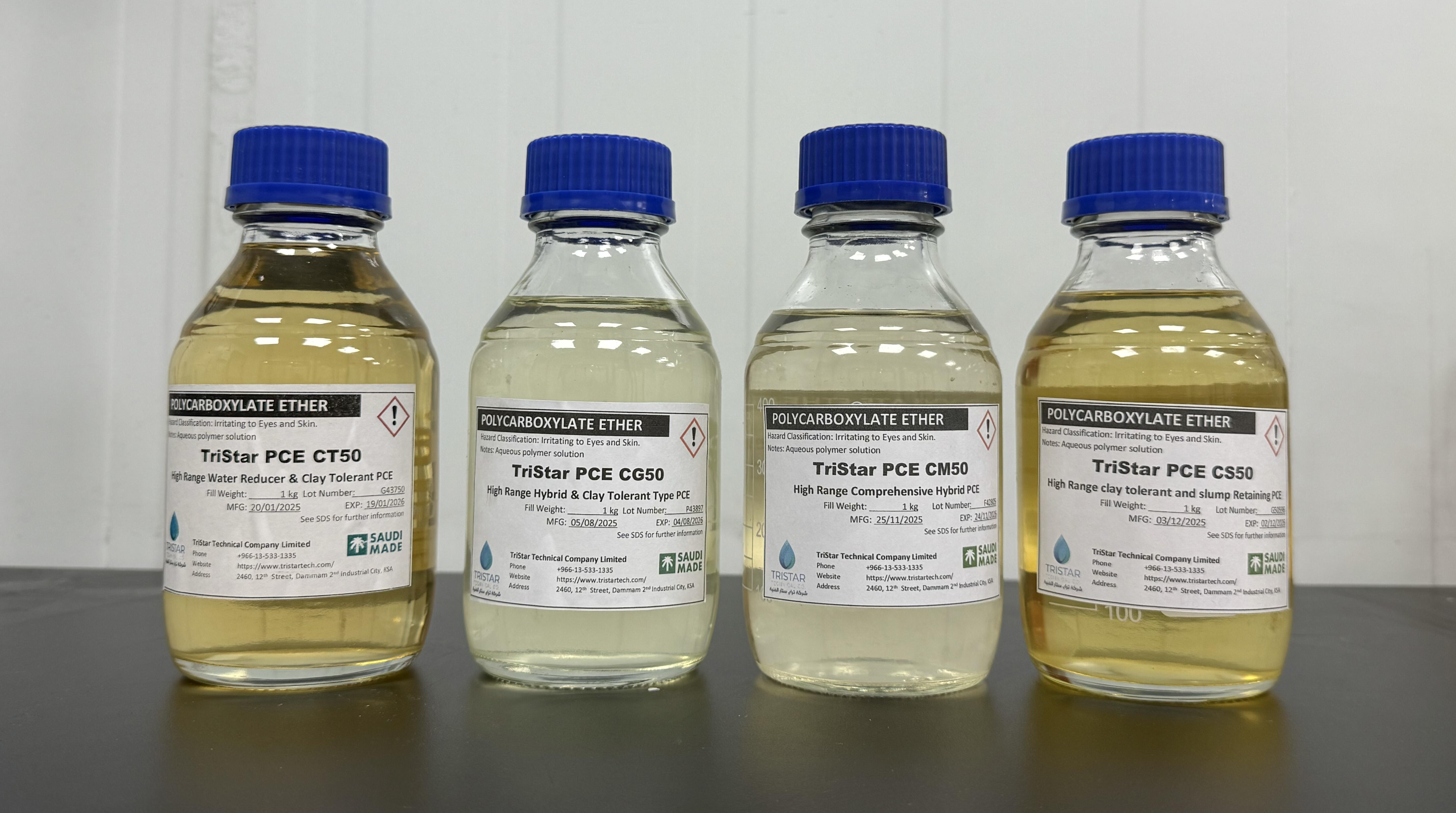
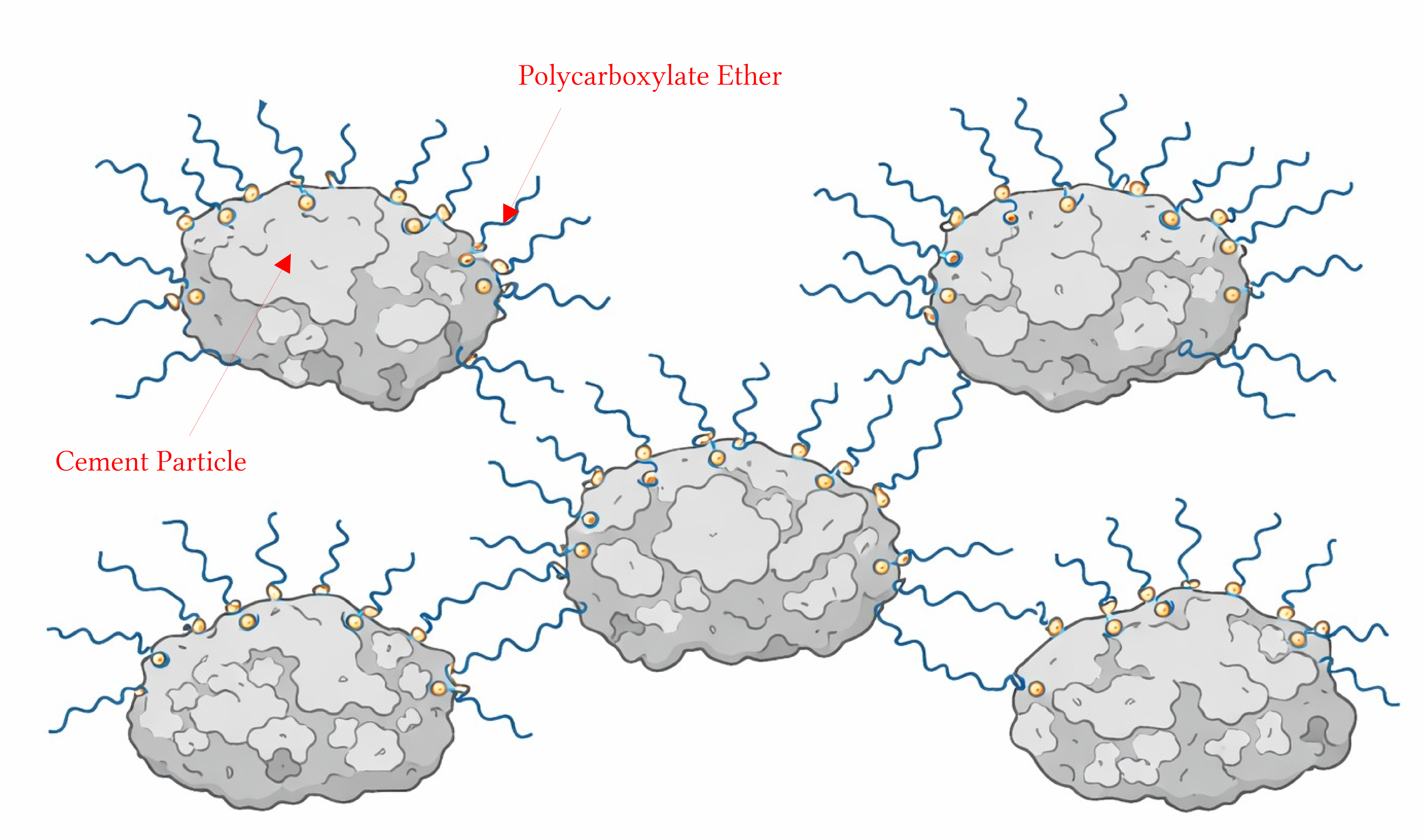
TriStar’s clay-tolerant PCE line is a family of high-range water-reducing superplasticizer polymers designed specifically for clay-contaminated environments. Unlike generic superplasticizers, this TriStar-developed polymer technology remains least sensitive to clay-bearing aggregates, meaning it resists being absorbed or intercalated by clay particles. In effect, the PCE continues to do its job of dispersing cement grains instead of getting “swallowed” by clay. Research on PCE–clay interactions supports this mechanism: introducing bulky side-chain substituents on a PCE can create a steric barrier that physically blocks the polymer from entering clay interlayers, thereby enhancing clay resistance[7][8]. TriStar’s proprietary polymer design likely employs similar innovations (without divulging chemical specifics), giving their superplasticizers a built-in “clay shield.” The result is a superplasticizer that maintains efficacy even when clay fines are present – a critical advantage in real-world concrete production where perfect aggregate cleanliness is hard to achieve.
Superior slump retention is another hallmark of this product line. TriStar’s PCEs are formulated not only to impart an initial workability boost, but to sustain that workability over time, avoiding the rapid slump loss that plagues many mixes (especially in hot weather or long hauls). In technical terms, these are comb-type PCE co-polymers engineered for controlled, gradual cement dispersion. Adjustments to molecular weight and side-chain chemistry can yield a slow-release effect, keeping concrete fluid for extended periods[9][10]. In fact, industry advances show that modern PCE superplasticizers can maintain over 85% of initial slump after 3 hours, whereas conventional high-range water reducers might fall below 40% in the same time[10]. Specifications for ready-mix concrete often target a 2-hour slump retention window (e.g. ensuring a slump flow of 320 mm after 2 hours)[11], and tailored PCE formulas are able to meet these requirements[12]. By leveraging proprietary chemistry, TriStar’s clay-tolerant polymers achieve exceptional slump retention without resorting to separate set retarders or re-dosing on site. This is a major benefit for ready-mix suppliers and contractors: the concrete remains highly workable and pumpable for longer, simplifying placement and reducing the risk of cold joints or rejected loads.
Importantly, TriStar offers these capabilities as an all-in-one solution. Traditionally, achieving both high water reduction and long slump life in a clay-rich mix might require combining multiple admixtures – for example, using a standard PCE for water reduction and a separate “slump extender” or adding special clay-conditioning agents[13]. Such multi-component approaches increase complexity and the chance of dosage errors or compatibility issues. In contrast, TriStar’s clay-tolerant PCE line replaces those combinations with a single, multifunctional polymer, simplifying mix designs. Patent descriptions of similar “slump-retaining and dispersing” copolymers note that a well-designed PCE can indeed eliminate the need to add other water-reducing agents in the mix[13]. TriStar’s products embody this principle – one superplasticizer that provides water reduction, slump retention, and clay tolerance all together, ensuring consistency and reliability batch after batch.
High Water Reduction for Strength and Efficiency
All PCE superplasticizers are known for dramatic water-reducing capability, and TriStar’s clay-tolerant series is no exception. These admixtures are classified as high-range water reducers (HRWR), capable of cutting the required mixing water by 25–35% or more compared to an untreated mix, while achieving the same (or greater) slump. Research confirms that polycarboxylate-based superplasticizers enable fresh concrete to be more workable using less water, directly translating to higher potential strength and durability in the hardened concrete[14]. By strongly dispersing cement particles, PCEs allow the water/cement ratio to be lowered without sacrificing flow. One study highlights that certain MPEG-type PCE polymers exhibit a “remarkable water reduction rate”[15], far beyond older admixture technologies. In practical terms, this means TriStar’s polymers can facilitate very low water-cement ratios, yielding concrete with high early strength and superior long-term compressive strength even in mixes with challenging aggregates[16]. In tests with clay-laden sands, using the right kind of PCE kept 28-day strengths on par with mixes made from clean sand, despite the clay presence[16]. This is a remarkable validation that high-performance PCEs like TriStar’s can overcome the strength reductions typically caused by clay impurities.
Another benefit of such effective water reduction is the ability to produce self-consolidating concrete (SCC) more easily. Because the TriStar PCEs provide both high fluidity and stability, concrete mixes can achieve self-compacting performance (flowing into forms under their own weight, with no vibration needed). For reference, traditional concrete slumps are about 100–200 mm, whereas an SCC mix has a slump flow of 500–700 mm[17] – a much more fluid consistency. TriStar’s admixtures empower concrete to reach these SCC-like slump flows, yet with controlled rheology to avoid segregation. The exceptional slump retention further means that a mix can be designed to have SCC workability at the plant and still be fluid upon placement at the site, even if there’s a delay or a long transit. This capability is particularly useful for complex pours, densely reinforced sections, or any situation where high-flow, self-leveling concrete is desired for speed and quality of construction.
Slump Retention and Ready-Mix Versatility
For ready-mix concrete operations, extended slump retention is a game-changer. TriStar’s clay-tolerant PCEs keep concrete workable for longer periods without additional water or re-tempering, which is crucial for deliveries over long distances or in hot weather. By preserving slump and flow, these admixtures give contractors more flexibility in placement and finishing. As one industry news source notes, advanced PCE slump retention admixtures are engineered to maintain desired slump “for several hours, even in extreme temperatures”[18]. This means a truckload mixed in the morning can still be pumped and placed in the afternoon with minimal loss of performance – an obvious advantage in busy urban job sites or where unforeseen delays occur.
TriStar’s PCE line is designed to perform reliably across a range of field conditions. Even at high ambient temperatures that would normally accelerate slump loss, these polymers regulate cement hydration and continue working to keep the mix fluid. They achieve this by a combination of mechanisms: strong initial dispersion (to get the mix flowing) and then a slow, controlled release of dispersing effect over time[9][19]. Unlike old-generation plasticizers (like naphthalene or melamine sulfonates) which might give only 30–45 minutes of workable time[20][21], the modern PCE structure can extend workability to 2–3+ hours while avoiding excessive set retardation. In practice, this not only prevents the need for on-site water addition (which can ruin the concrete’s strength), but also ensures consistent quality: the last pour of the day can have the same slump as the first, yielding uniform strength and finish.
Crucially, TriStar’s clay-tolerant PCEs maintain slump even when supplementary cementitious materials (SCMs) are used. Many concrete mixes today incorporate fly ash, slag, silica fume, calcined clay, or other SCMs to improve sustainability and performance. However, these additions can sometimes upset admixture performance (for instance, some PCEs have difficulty with the chemistry of high fly ash mixes or with the fineness of silica fume). Compatibility with SCMs was a key design goal for TriStar’s admixtures. The proprietary formulation tolerates a wide range of cement chemistries and mineral admixtures, ensuring that the water-reducing and slump-retaining effects hold steady even in blended cement systems. A 2025 industry review emphasized that ensuring PCE adaptability in low-clinker, blended cement systems is an ongoing challenge for admixture technology[22]. TriStar’s innovation meets this challenge head-on. Field data from similar next-generation PCEs show stable performance with cements rich in C₃A and mixes containing fly ash or slag, conditions that traditionally complicate admixture behavior[23]. In other words, whether the concrete contains 50% slag cement, 30% fly ash, or other pozzolans, TriStar’s clay-tolerant PCE will work seamlessly, providing the same high water reduction and slump retention benefits without needing formula tweaks or special dosage adjustments. This makes these admixtures highly versatile for ready-mix producers who deal with varying materials – one product can gracefully handle multiple mix designs (from 100% OPC to high-SCM “green” concrete), simplifying inventory and mix optimization.
Simplified Mixes, Cost Efficiency, and Reliable Performance
By combining multiple functions into a single high-performance admixture, TriStar’s clay-tolerant PCE polymers deliver significant cost and operational advantages. First, there is a direct cost savings in material usage: using this advanced superplasticizer, contractors can often reduce the total cement content or replace more cement with cheaper SCMs while still achieving target strength, thanks to the improved dispersion and hydration efficiency. (Maintaining lower water/cement ratios through superior dispersion can yield equal strength with less cement, directly cutting material cost and the carbon footprint of the concrete.) Additionally, as noted earlier, enabling the use of locally sourced aggregates without extensive washing or beneficiation means cheaper aggregate supply and less waste of water[6]. All these factors contribute to a lower cost per cubic meter of concrete.
Second, mix simplicity and consistency improve. Rather than juggling a cocktail of admixtures (with one product to counteract clay, another to extend slump, etc.), a single TriStar PCE does the heavy lifting. Fewer admixture components mean easier quality control and reduced risk of incompatibilities or dosing errors on site. This not only streamlines the concrete batching process but also improves reliability – every truckload gets the same admixture and will behave predictably. One can formulate a robust mix design upfront, knowing that the admixture will handle variations in sand quality or ambient conditions. The end result is performance reliability: the concrete will achieve the required strength, flow, and set time consistently, even when some variables (like clay content or temperature) would normally throw results off. As one review succinctly put it, “tailored PCE modifications can significantly diminish clay sensitivity, offering practical solutions for improving the performance of cementitious materials in clay-contaminated environments.”[24] TriStar’s clay-tolerant line is exactly such a solution – it yields concrete that is forgiving to real-world materials, robust in different conditions, and trustworthy in its performance outcomes.
Finally, TriStar’s solution is designed with cost-efficiency and value in mind. The company’s innovations focus not just on performance metrics, but also on delivering those gains economically. The clay-tolerant PCE polymers are high-solids, efficient admixtures, meaning dosage rates are optimized to be cost-effective. Because they replace multiple additives, the overall admixture cost for a project can be lower, and logistics are easier (fewer different admixture tanks or dispensers needed). In the patent description of a similar technology, the inventors highlight “good anti-mud effect, low cost” as a key benefit[3] – a testament that a well-designed clay-tolerant superplasticizer should not only perform well but do so at reasonable cost. TriStar’s products embody this principle, offering mix economy alongside high performance.
In summary, TriStar’s clay-tolerant PCE polymer line represents a significant advancement for concrete admixtures used in challenging aggregate conditions. This family of admixtures provides superior water reduction, translating to high strength and durability; it offers exceptional slump retention, ensuring long-lasting workability and supporting self-compacting concrete applications; and it exhibits remarkable clay tolerance, maintaining efficacy and consistency even with clay-contaminated sands or varied cementitious materials. By consolidating these benefits into one TriStar-developed polymer system, concrete producers and contractors can achieve simpler, more reliable, and more cost-effective mix designs. Whether the goal is ultra-high-performance concrete or just a dependable everyday mix that won’t be thrown off by a little dirt, TriStar’s clay-tolerant PCE admixtures deliver performance with peace of mind – high-strength, highly workable concrete with fewer hassles, even when materials are less than ideal.
About TriStar Technical Co.:
TriStar Technical Co. is a Saudi Arabian company and the leading provider of Polycarboxylate Ethers (PCE) in the region. With our state-of-the-art manufacturing facility in Dammam, we offer a diverse range of PCE grades, including high-range water reducers, slump retainers, hybrids, early strength agents, and clay-tolerant solutions. Our commitment to quality and customer satisfaction enables us to meet the specific needs of the construction industry.
References:
- Mlalazi, S. et al. (2019). Evaluation of Polycarboxylate Ethers that can Mitigate the Detrimental Effects of Clay Content of Sand on Concrete Workability and Strength. Chem. Eng. Trans. 76, 475-480 [6][16]
- Sun, C. et al. (2015). The Clay-Tolerance of Amide-Modified PCE and Its Performance with Clay-Bearing Aggregates. Int. Conf. on Materials, Environmental & Biological Engineering (MEBE 2015)[1][2]
- Zhang, Y. et al. (2025). Polycarboxylate Superplasticizers: Structural Design, Application Technology, and Future Directions. J. Chinese Ceram. Soc. 53(3):574 (Review)[15][25]
- Gao, Y. et al. (2023). Interaction Between PCE Superplasticizer and Clay in Cement and Its Sensitivity Inhibition Mechanism: A Review. Materials 18(11): 2662[7][24]
- Patent CN109626859A (2019). Clay-resisting slow-release slump-retaining polycarboxylate superplasticizer (Shanxi Huanghe New Chemical Co.)[3]
- Patent US20130231415A1 (2013). Slump Retaining and Dispersing Agent for Hydraulic Compositions[13]
- Danish Technological Institute (2008). Guidelines for SCC Mix Design (SCC Consortium)[17]
- Advances in Slump Retention Technology for Hot Weather Concreting[9][10]